Practical DSP Tuning Workflow for On-Boat EQ and Crossover Setup
A reliable tuning workflow reduces guesswork when applying EQ and crossovers on a vessel where reflections, hull resonance and speaker placement change quickly. Start by gathering objective measurements: use a calibrated measurement mic and capture impulse responses at several listening positions while the boat is stationary. Import these IRs into the DSP environment to produce averaged frequency-response and time-domain plots. From there, apply corrective narrow-band EQ for clear notches caused by cabin modes, followed by broader shelving adjustments for tonal balance. Always verify changes with real program material and check for interaction between crossover slopes and EQ boosts — steep low-frequency boosts near crossover points often mask phase issues that manifest as lobing when two speakers overlap.
Designing Crossovers with Phase and Power in Mind
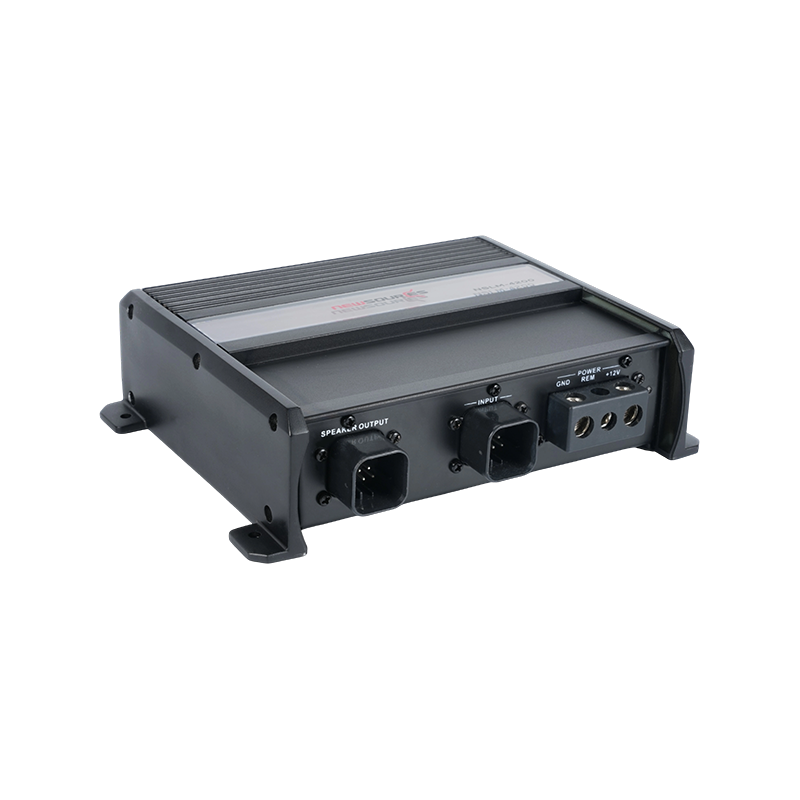
When configuring multiband crossovers in a multichannel marine amplifier, treat the crossover as both a frequency filter and a phase-management tool. Choose slope types and orders based on driver capability and intended overlap: Linkwitz-Riley 24 dB/octave pairs often give coherent phase at the crossover when both drivers are full-range rated, while gentler slopes may be required where power handling or driver linearity is marginal. Use the DSP’s linear-phase or minimum-phase options thoughtfully — linear-phase filters preserve impulse timing but add pre-ringing that can sound unnatural at high Q; minimum-phase filters are more musical but shift timing which must be corrected with delay. Always confirm that channel power distribution across the amplifier channels remains within thermal and supply headroom when low-frequency content is routed to subwoofer outputs.
Practical checklist for crossover setup
- Verify driver frequency ranges and apply conservative crossover points that respect excursion and power handling.
- Set initial slope to 12–24 dB/octave, then audition and inspect phase alignment across the passband.
- Monitor supply voltage and channel current during full-band testing to ensure the Class D stages remain thermally stable under intended loads.
Time Delay Correction and Spatial Imaging on Boats
Time alignment is often the simplest way to improve imaging in asymmetric installations common on boats (e.g., cockpit speakers offset from helm seat). Use the DSP’s delay blocks to align acoustic centers so that direct sound from multiple drivers arrives within a few milliseconds of each other at primary listening positions. Measure and set delay in meters or milliseconds using the impulse response; then refine by ear. When using multiple listening seats, create two or more DSP Marine Amplifier with slightly different delay matrices rather than a single compromise setting. This approach is particularly effective when the amplifier supports multiple stored presets and remote selection from a control head.
SigmaStudio Frames and Custom Algorithm Building for Installer Flexibility
Building SigmaStudio frames tailored to a boat’s speaker topology streamlines dealer commissioning: include modular blocks for parametric EQ, crossover bands, delay, and dynamic limiters so an installer can activate or bypass functions without reprogramming the whole patch. Pre-compute suggested EQ templates for common hull types (open deck, enclosed cabin, hardtop) and embed them as selectable snapshots. Where computational resources permit, implement adaptive filters that limit corrective gain when overall SPL exceeds a threshold, protecting drivers and preserving clarity during peak passages.
Deployment tips for SigmaStudio-based setups
- Provide factory presets for typical boat classes and a “set-and-lock” option to prevent unintended changes by end users.
- Document recommended parameter ranges (Q, gain, crossover frequency) in the frame to reduce installer trial-and-error.
- Include an exportable measurement profile with each tuning session to support future updates or warranty diagnostics.
Balancing DSP Precision with Marine Reliability Requirements
Precision tuning must coexist with marine reliability: aggressive EQ that requires high channel gains can push Class D stages and power supplies into thermal limits, especially in compact enclosures. When building DSP presets, cap maximum gain and implement soft-limiters that reduce gain smoothly when thermal or supply thresholds are approached. Integrate signal-sensing features so that the amplifier enters low-power standby when no audio is present, preserving battery life without requiring the installer to change wiring. These design choices are practical and protect long-term component life in salt-air environments.
| Tuning Task |
Recommended DSP Function |
Practical Benefit |
| Cabin mode suppression |
Narrow-band parametric EQ |
Reduces boom and improves mid-bass clarity |
| Imaging correction |
Time delay and polarity controls |
Improves stereo focus at helm and passenger seats |
| Driver protection |
Soft-limiters and dynamic limiters |
Prevents over-excursion and amplifier clipping |
Commissioning and Dealer Handover: Documentation That Saves Time
A smooth handover includes annotated measurement files, the list of active DSP blocks with parameter snapshots, and a simple user guide showing how to switch presets. Provide dealers with a checklist that includes verification of connector sealing, confirmation of supply headroom under full-band test, and a final listening audit. These deliverables reduce return visits and improve owner satisfaction because the system is both tuned and robustly constrained for marine use.
Combining a field-oriented tuning methodology, SigmaStudio configurability and conservative protection strategies yields a DSP marine amplifier deployment that is both sonically flexible and operationally durable — exactly the balance required for high-performance boat audio systems in real-world marine environments.


 EN
EN

 English
 Español
 عربى
عربى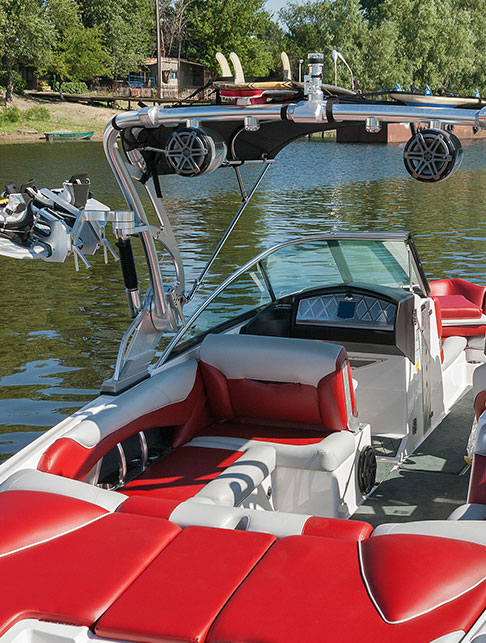







.jpg)
.jpg)