
 EN
EN
 English
 Español
 عربى
عربىContent
- 1 What a Car Amplifier Actually Does in the Signal Chain
- 2 Channel Count, Power and Speaker Matching
- 3 Class A/B or Class D? Amplifier Topology Matters
- 4 Installation Details That Decide the Result
- 5 When a Standard Car Amplifier Is Not Enough
- 6 How to Specify a Car Amplifier for an Upgrade
- 7 What to Look For in a Manufacturing Partner
- 8 Final Thoughts
A car amplifier is the part of an audio system that turns a small line-level signal into enough electrical energy to actually move speaker cones. Factory radios and aftermarket head units contain amplifiers of their own, but they are usually limited to a handful of watts per channel. That is why an outboard amplifier remains one of the most cost-effective upgrades in car audio. Since 1997 our team at Newsources has designed and manufactured amplifiers for cars, boats and powersport vehicles, and the questions we hear from installers rarely change: how many channels, how much power, which class, and how to keep noise out of the system.
This guide walks through the decisions that genuinely shape the result, from channel count and amplifier topology to installation details and the point at which a standard car amplifier is no longer the right tool for the job.
What a Car Amplifier Actually Does in the Signal Chain
An amplifier does one job: it takes the low-voltage audio signal leaving the source unit and raises it to a level that can drive speakers with control. The signal path in a typical upgrade looks like this:
- Source: factory head unit, aftermarket radio, or a phone streaming over Bluetooth.
- Signal conditioning: a line output converter or DSP takes the high-level output of a factory radio and converts it into a clean low-level signal.
- Amplification: the car amplifier applies voltage and current gain, set through the gain control.
- Distribution: passive crossovers, or the amplifier's built-in filters, split the signal to tweeters, midrange drivers and subwoofers.
Every factory radio already includes a small amplifier, typically rated somewhere between 10 and 20 watts per channel. That is adequate at low listening levels, but it clips early once the volume rises, and clipped signals are what actually destroy speakers. A separate amplifier preserves headroom, so transients stay clean and the system sounds composed instead of strained.
Channel Count, Power and Speaker Matching
Channel count is the first practical decision, and it should follow the speaker layout rather than the other way around. The table below maps common configurations to the systems they usually serve.
| Configuration | Typical system goal | What to verify |
|---|---|---|
| 1-channel mono block | One or more subwoofers | RMS output at the actual load impedance |
| 2-channel | Front speakers, or two channels bridged to a sub | Bridge stability and minimum impedance |
| 4-channel | Front and rear speakers, or front plus a bridged sub | Filter flexibility per channel pair |
| 5-channel | Complete system in a single chassis | Shared power supply and subwoofer channel rating |
| 6-channel | Three-way front stage, or front, rear and sub | Active crossover capability |
| 8-channel | Multi-zone or DSP-driven active systems | Gain matching and processing integration |
Power ratings deserve the same scrutiny. Continuous RMS figures measured at a stated impedance tell you far more than an inflated peak number. A well-built 4-channel amplifier delivering honest power into four ohms will outperform a cheap unit that advertises twice the output on paper but cannot sustain it once the heatsink warms up.
Class A/B or Class D? Amplifier Topology Matters
Class A/B Amplifiers
Class A/B designs have been the backbone of car audio for decades. They produce a smooth, predictable sound, tolerate a wide range of loads, and are straightforward to service. Their trade-off is efficiency: a substantial share of the energy they draw becomes heat, so they need more space and better airflow for the same output. For moderate power levels and full-range speaker duty, a clean Class A/B amplifier is still an excellent choice.
Class D Amplifiers
Class D amplifiers switch rapidly and lose much less energy as heat, which is why they dominate subwoofer duty and high-power applications. Modern full-range Class D designs have closed much of the sonic gap that once separated the two topologies, and their compact size makes them easier to fit behind trim panels or under seats. Our own car amplifier range keeps both topologies in production for exactly this reason: the right answer depends on the load, the space and the listening goal.
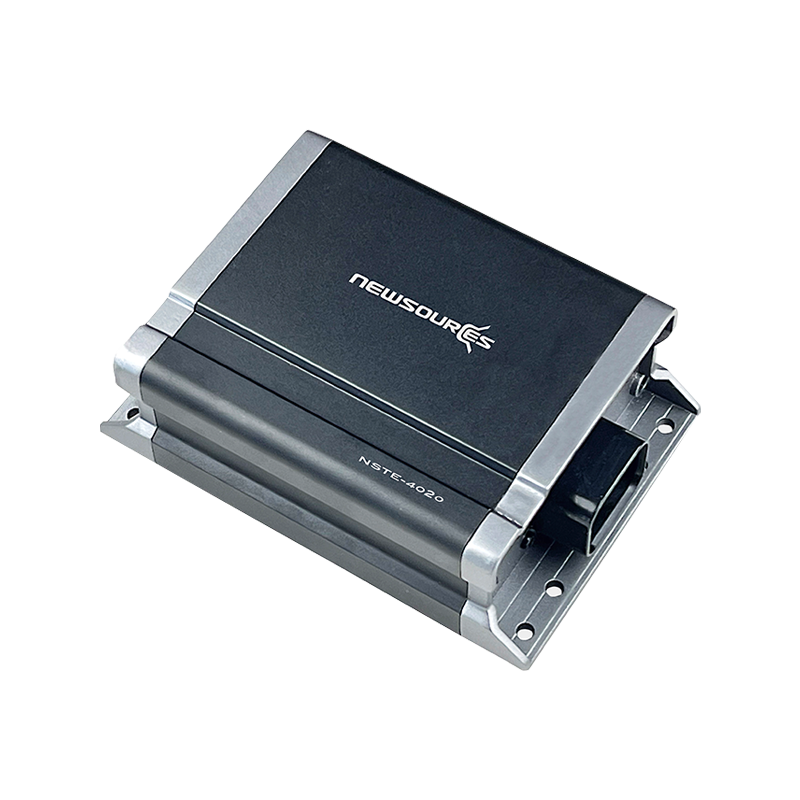
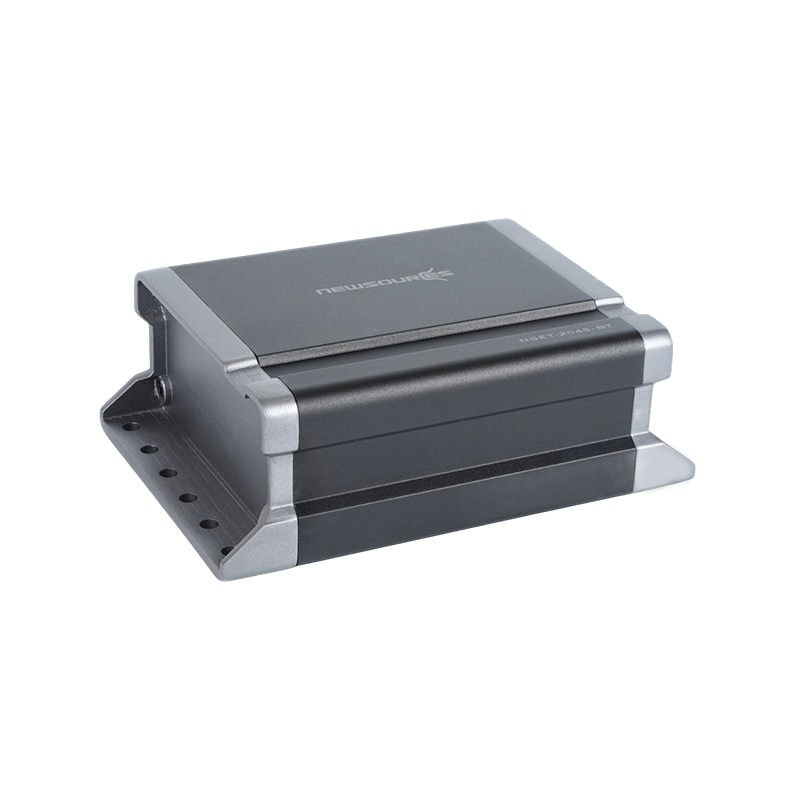
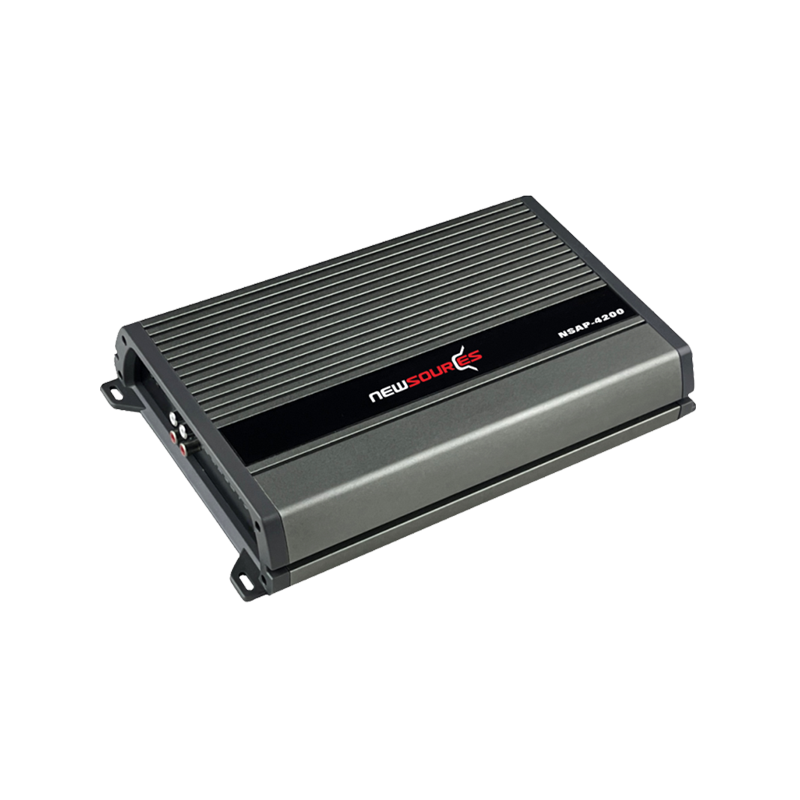 4 Channel Class D Amplifier4 x150W @ 4ohms, 4 x 200W @ 2ohms, 1% THDView Product →
Installation Details That Decide the Result
Hardware choices matter, but installation quality decides whether an amplifier performs at its rating. Power wiring should be sized to the current draw, fused close to the battery, and grounded to a bare metal point of the chassis with equal-gauge cable. Signal cables should run on the opposite side of the vehicle from power cable wherever possible.
Noise is the most common complaint, and it almost always has a traceable cause:
- Ground loops created by differing ground potentials between the source unit and the amplifier.
- Induced engine noise from alternator whine or ignition interference.
- Gain controls set too high, which amplifies noise floor rather than music.
- Poor signal matching between a factory radio's high-level output and the amplifier's input.
Ground loop isolators, engine noise filters and high-to-low level converters exist precisely to solve these problems, and a properly matched converter often removes noise before it ever reaches the amplifier. For systems built on a factory radio with multiple channels, a multi-channel converter keeps the front, rear and subwoofer signals separated and adjustable.
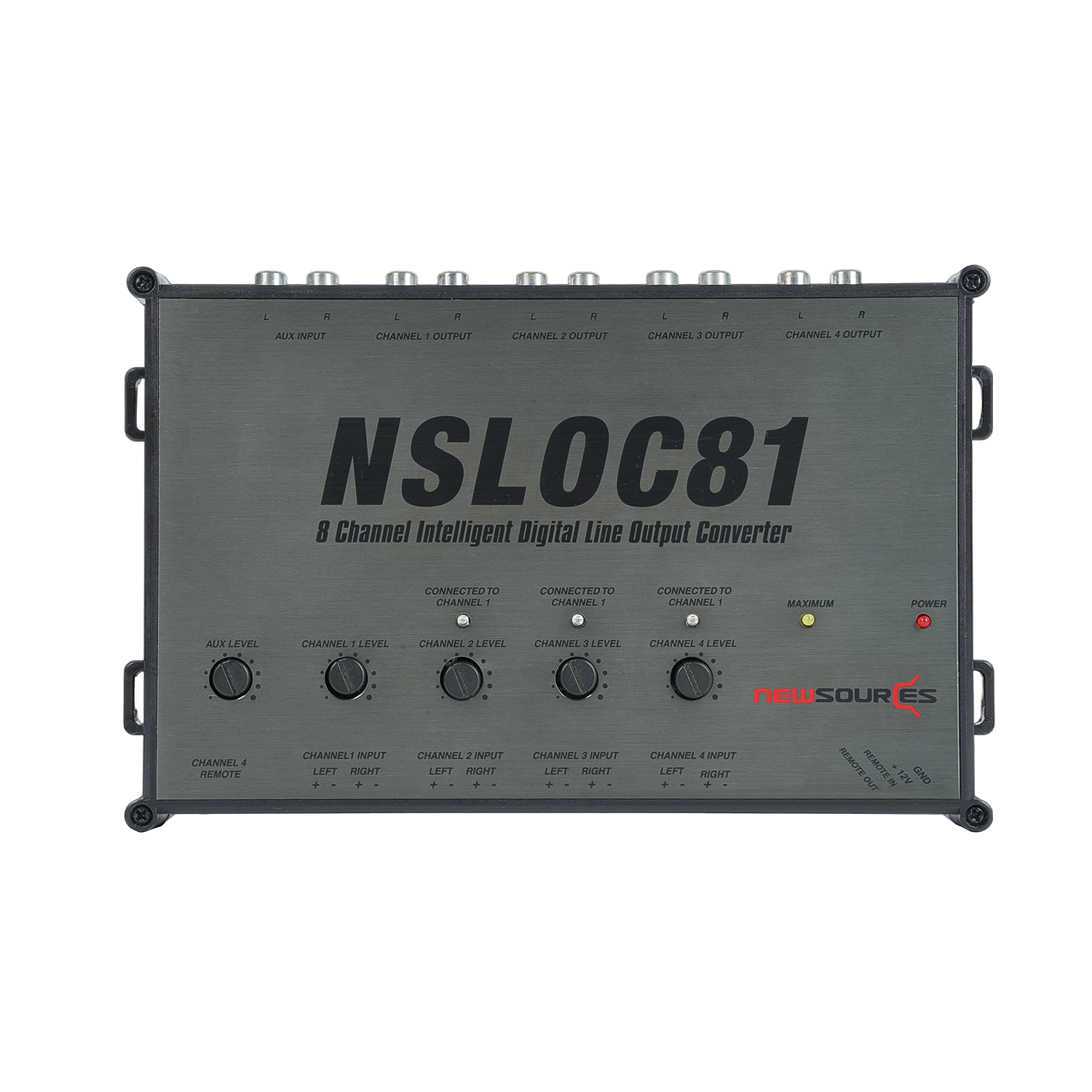 8 Channel Hi-low Level Converter with AUX InputSeparate channel input adjustmentView Product →
When a Standard Car Amplifier Is Not Enough
Not every vehicle offers a dry, temperature-controlled cabin. Once an amplifier leaves the passenger compartment, sealing, corrosion resistance and load stability become the specification priorities.
Marine Systems
Boats expose electronics to humidity, spray and salt, and audio systems are often distributed across several listening zones. Marine amplifiers need conformal protection, stable performance under continuous high output, and enough channels to feed multiple speaker areas. Adding digital signal processing allows delay, equalization and crossover points to be tuned for open-air acoustics that behave nothing like a car interior.
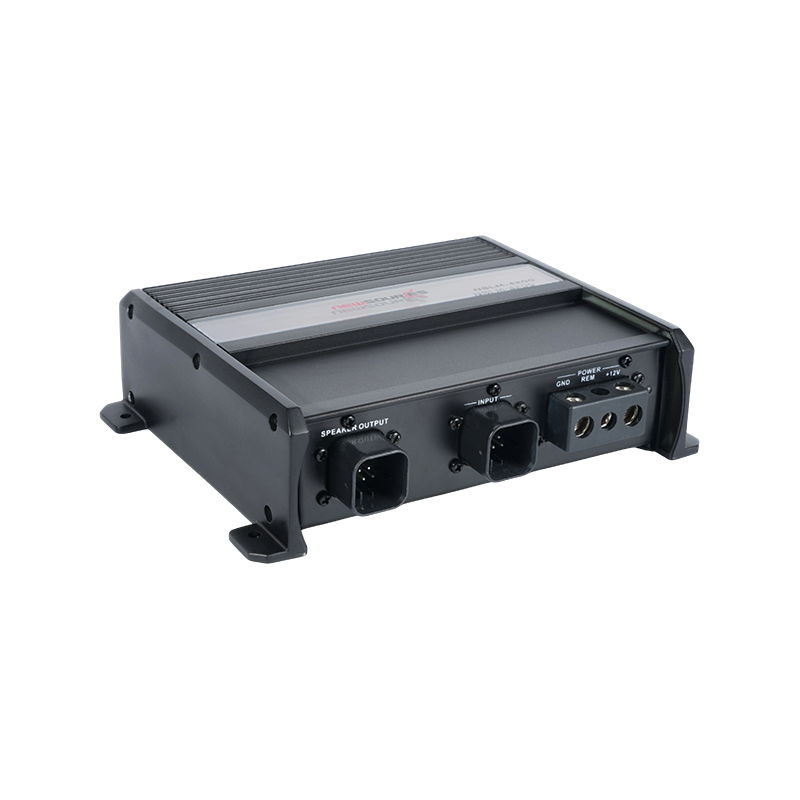 4 Channel Full Range Class D Marine Amplifier4 x 150W @ 4ohms,4 x 200W @ 2ohms, 1% THD,14.4VView Product →
Powersport and Motorcycle Applications
Motorcycles and side-by-sides combine vibration, water exposure and very limited mounting space. Amplifiers rated to IPX5, IPX6 or IPX7 handle rain and washdown, while compact chassis designs fit inside fairings and saddlebags. If you are weighing these against conventional car audio hardware, this overview of how motorcycle amplifiers differ from car amplifiers covers the practical distinctions.
Older Vehicles and Bluetooth Integration
For vehicles with a factory system that lacks streaming, a Bluetooth receiver, controller or hub can feed an amplifier's RCA inputs without replacing the radio. Amplifiers with Bluetooth built in simplify the layout further, keeping the signal path short and the installation clean.
How to Specify a Car Amplifier for an Upgrade
- Define the speaker layout first, including whether a subwoofer will be added.
- Choose the channel count that covers that layout without wasting channels.
- Calculate the continuous RMS power the speakers and subwoofer can use safely.
- Confirm the amplifier is stable at your final load impedance, including bridged configurations.
- Select the topology that fits your space and thermal environment, such as a compact Class D chassis where airflow is limited.
- Plan the wiring, fusing, grounding and signal conversion before the first panel comes off.
- Set gains with the head unit at roughly three-quarters volume to preserve headroom and avoid noise.
What to Look For in a Manufacturing Partner
When amplifiers are purchased for a brand, a retail chain or a vehicle program rather than a single installation, the questions shift toward consistency and capacity. Our own footprint spans three production sites in Hangzhou, Deqing and Cambodia, covering roughly 37,000 square meters with more than 150 employees and more than 15 assembly lines. Production includes SMT placement, AOI optical inspection, wave soldering, AP testing and 100 percent burn-in before packing.
The product catalogue we maintain reflects how installers actually build systems: Class A/B and Class D car amplifiers, compact mini amplifiers, powersport and marine amplifiers with defined IP ratings, Bluetooth-enabled models, plus the supporting parts that make an installation work, such as line output converters, noise filters, bass processors, in-dash equalizers, passive crossovers, RGB lighting controllers and 24V to 12V DC power inverters. Buyers evaluating a supplier should ask for test criteria, sample evaluation terms, lead times and minimum order quantities, since those details matter more than a brochure photograph.
Final Thoughts
A car amplifier is a system component, not an isolated purchase. Channel count follows the speaker layout, power follows the drivers, topology follows the installation environment, and the final result follows the quality of the wiring and setup. Get those four decisions right and the amplifier disappears into the background, which is exactly what good audio equipment should do.