
 EN
EN
 English
 Español
 عربى
عربىContent
- 1 Why Your Car Needs a Dedicated Amplifier
- 2 Understanding Amplifier Classes: A, B, AB, and D
- 3 Channel Configurations and How to Match Them to Your System
- 4 RMS Power, Peak Power, and Why the Difference Matters
- 5 Impedance Matching: Getting the Most Power Safely
- 6 Built-In Features That Affect Sound Quality and Usability
- 7 Installation Essentials: Power, Ground, and Signal Wiring
Why Your Car Needs a Dedicated Amplifier
The factory-installed head unit in most vehicles delivers between 15 and 22 watts RMS per channel — enough to fill a quiet cabin at low volume, but nowhere near sufficient to drive aftermarket speakers cleanly or reproduce bass with any authority. When you push a stock head unit past 70% volume, the signal clips, introducing distortion that damages tweeters and degrades sound quality. A dedicated car amplifier solves this by accepting the low-level signal from the head unit, amplifying it cleanly to levels that aftermarket speakers and subwoofers are designed to receive, and doing so with significantly lower distortion figures than any built-in amplifier can achieve. The result is louder, clearer, and more dynamic sound at every volume level.
Choosing the right amplifier, however, requires more than picking the one with the highest watt rating on the box. Power handling compatibility, channel configuration, impedance matching, installation space, and budget all play a role in determining which amplifier will genuinely improve your system and which will underperform or fail prematurely. This guide walks through every major decision point so you can make a confident, informed purchase.
Understanding Amplifier Classes: A, B, AB, and D
Car amplifiers are built around different circuit topologies, each of which affects sound character, efficiency, and heat output. Understanding the class of an amplifier helps you match it to the right application in your vehicle.
- Class A: The output transistors conduct for the full cycle of the audio waveform, producing extremely low distortion and a warm, detailed sound. However, Class A amplifiers are highly inefficient — typically only 15–30% of the power drawn from the battery is converted to audio output, the rest becoming heat. They are rarely used in car audio due to their size, heat generation, and current draw.
- Class B: Each half of the audio waveform is handled by a separate transistor, improving efficiency to around 70%, but introducing crossover distortion where the two transistors hand off the signal. Pure Class B is uncommon in high-quality audio applications.
- Class AB: The most common class for full-range car amplifiers. It combines Class A operation at low levels (for low distortion) with Class B efficiency at higher output. Typical efficiency is 50–70%. Class AB amplifiers deliver excellent sound quality for door speakers, midrange drivers, and tweeters, making them the standard choice for multi-channel amplifiers.
- Class D: Uses switching transistors that turn on and off at very high frequencies (typically 200–400 kHz) to reproduce the audio signal. Efficiency reaches 80–95%, meaning very little power is wasted as heat. Class D amplifiers are compact and run cool, making them ideal for subwoofer amplifiers and installations with limited space. Modern Class D designs have closed the sound quality gap significantly, and many audiophile-grade Class D amps now rival Class AB for full-range use.
Channel Configurations and How to Match Them to Your System
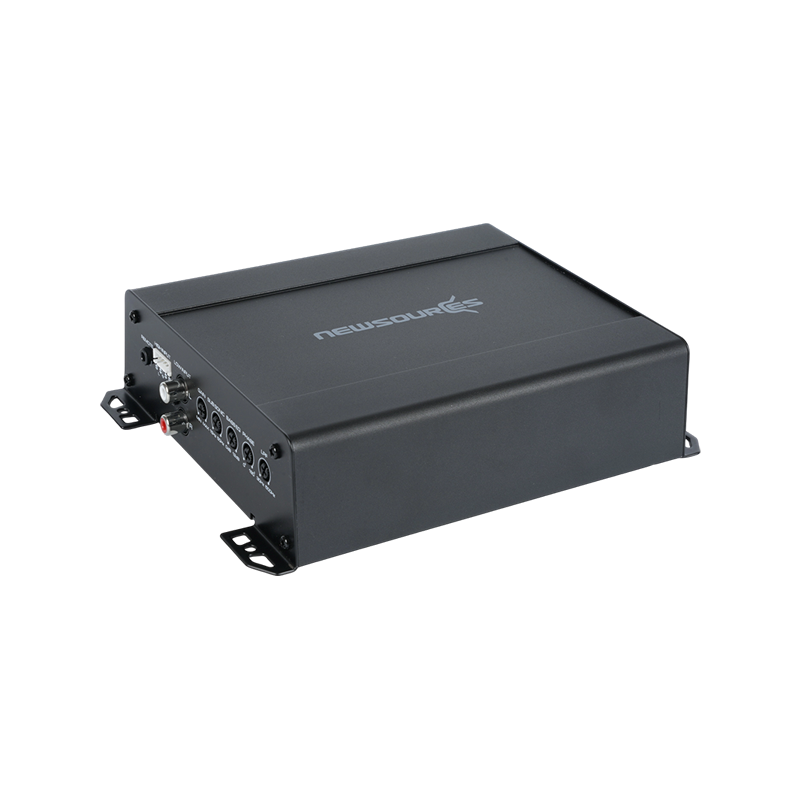
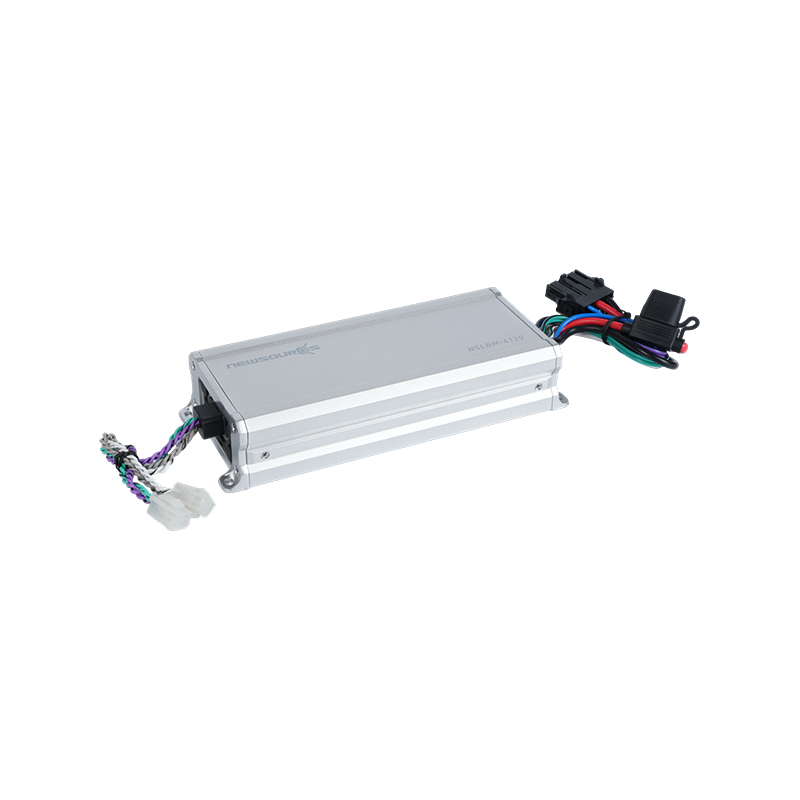
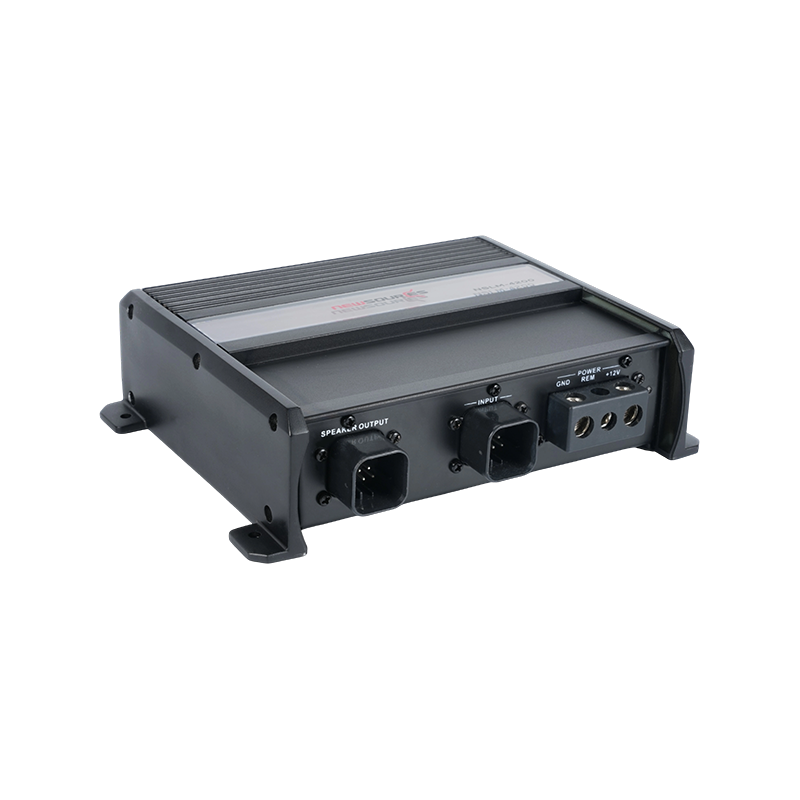
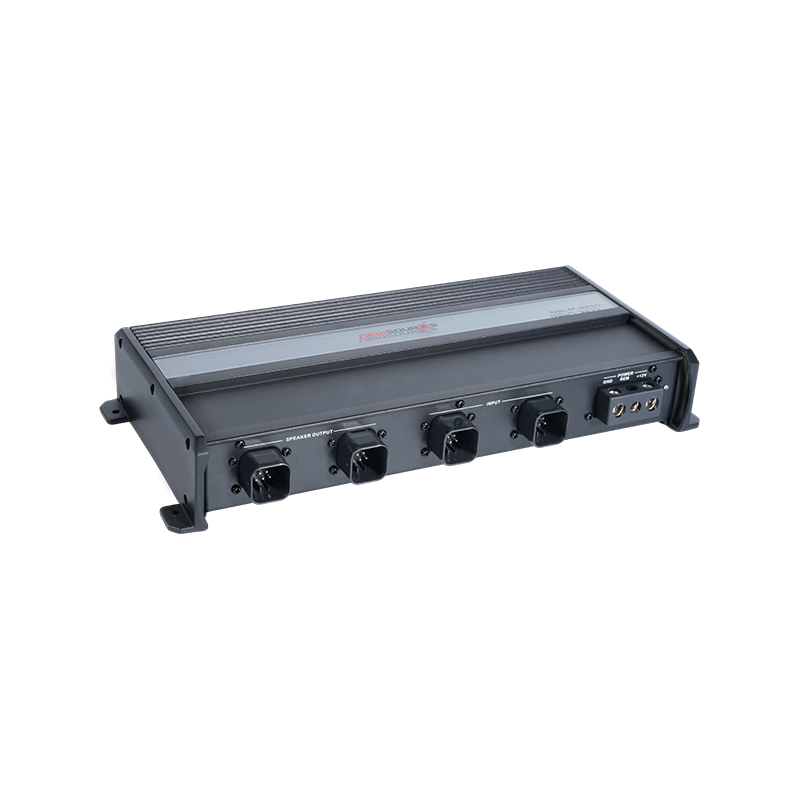
Car amplifiers are available in mono, two-channel, four-channel, and five-channel configurations. The right choice depends entirely on what speakers and subwoofers you are driving.
Monoblock Amplifiers
Monoblock amplifiers have a single channel optimized for subwoofer duty. They are typically Class D for efficiency and are designed to deliver high current at low impedances — commonly 1 ohm or 2 ohms. If your system includes one or more subwoofers, a dedicated monoblock is almost always the best choice. Power ratings for monoblock amplifiers commonly range from 200 watts RMS to over 2,000 watts RMS for competition-level builds.
Two-Channel Amplifiers
A two-channel amplifier can power a pair of component speakers, a pair of coaxial speakers, or be bridged to a single mono output for a subwoofer. Bridging combines both channels into one, roughly doubling the voltage swing and therefore the power output — though the minimum load impedance doubles as well, so a bridged two-channel amp rated for 4-ohm stereo should only be bridged into an 8-ohm load. Two-channel amps are a versatile option for smaller systems or as the second amplifier in a more complex installation.
Four-Channel Amplifiers
Four-channel amplifiers are the backbone of most full car audio upgrades. They power all four door speakers (or a front component set plus rear fill speakers) from a single unit. Many four-channel amplifiers can also be configured as a two-channel amp plus a bridged mono channel, allowing a single unit to drive both the full-range speakers and a subwoofer in a compact installation. This makes them especially practical when trunk or under-seat space is limited.
Five-Channel Amplifiers
Five-channel amplifiers integrate a four-channel section for full-range speakers with a high-powered mono channel for the subwoofer, all in one chassis. They reduce wiring complexity, require fewer power and ground connections, and take up less installation space than two separate amplifiers. The trade-off is that if one section fails, the entire unit must be serviced. They are an excellent choice for enthusiasts who want a significant upgrade without the complexity of a multi-amplifier system.
RMS Power, Peak Power, and Why the Difference Matters
The most misunderstood specification in car audio is wattage. Manufacturers frequently advertise peak power ratings that can be two to four times higher than the amplifier's actual continuous (RMS) output. Peak power is the instantaneous maximum the amplifier can produce for a fraction of a second under ideal conditions — it has no bearing on real-world performance. RMS power is the continuous power the amplifier can deliver indefinitely without distortion or thermal shutdown, and it is the only figure that should be used when matching an amplifier to speakers.
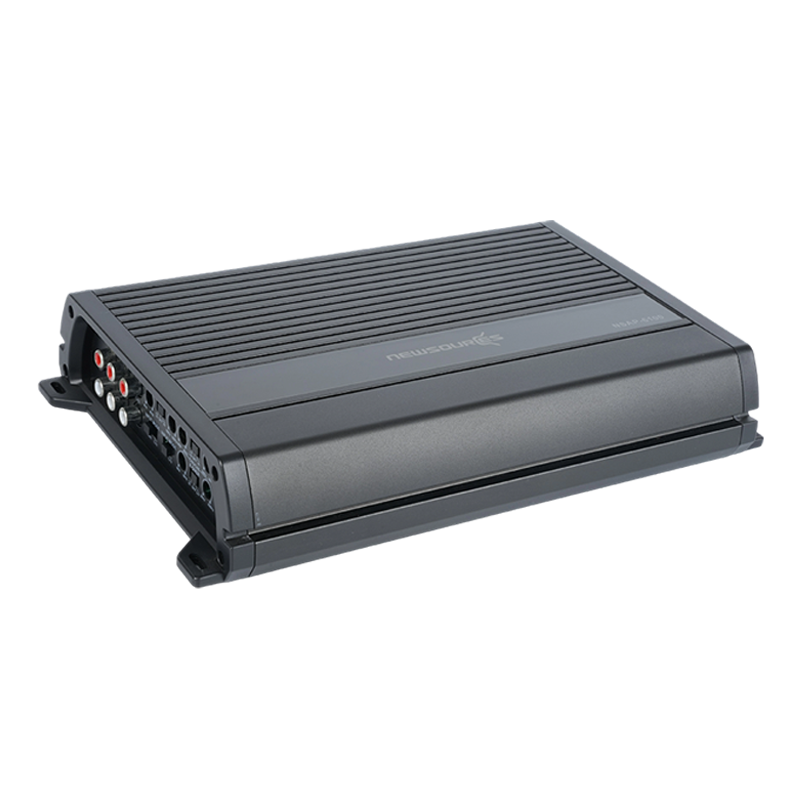
Your speakers' RMS power handling rating should be within approximately 75–150% of the amplifier's RMS output per channel. Underpowering speakers with a clipping amplifier causes more speaker damage than moderate overpowering with a clean signal, because clipped waveforms contain high-frequency harmonics that destroy tweeters. Always compare RMS to RMS when reading specifications, and when in doubt, request CEA-2006 compliant power ratings, which are the industry standard for honest amplifier measurement.
Impedance Matching: Getting the Most Power Safely
Impedance, measured in ohms, determines how much resistance the speaker presents to the amplifier. Most car speakers are rated at 4 ohms, while many subwoofers have dual voice coils that can be wired to present 1, 2, or 4 ohms to the amplifier. Amplifiers are designed to deliver more power into lower impedance loads — a typical monoblock might produce 500 watts at 4 ohms, 800 watts at 2 ohms, and 1,200 watts at 1 ohm.
However, operating an amplifier below its minimum rated impedance causes excessive current draw, overheating, and can trigger protection circuits or cause permanent failure. Always verify the amplifier's minimum stable impedance before wiring your subwoofer in a low-impedance configuration. The following table summarizes common wiring configurations for dual voice coil (DVC) subwoofers:
| DVC Sub Rating | Series Wiring | Parallel Wiring |
| DVC 2Ω | 4Ω | 1Ω |
| DVC 4Ω | 8Ω | 2Ω |
Built-In Features That Affect Sound Quality and Usability
Beyond raw power, the onboard processing features of a car amplifier have a significant impact on how well it integrates into your specific vehicle and source unit. Key features to evaluate include:
- Crossover filters: High-pass filters (HPF) block low frequencies from reaching full-range speakers to prevent distortion and overexcursion. Low-pass filters (LPF) limit subwoofer amplifiers to bass frequencies only. Variable crossover points — ideally adjustable from 50 Hz to 500 Hz — give you precise control over the frequency range each speaker reproduces.
- Bass boost: A parametric bass boost centered around 40–80 Hz can add impact to a subwoofer, but it should be used sparingly — no more than 6 dB — as excessive boost increases power demand and distortion significantly.
- Subsonic filter: Essential for vented (ported) subwoofer enclosures, a subsonic filter rolls off frequencies below the box's tuning frequency where the subwoofer cone moves freely with no acoustic load. Without it, excessive excursion at very low frequencies can mechanically destroy the driver.
- Signal sensing and auto-turn-on: Amplifiers can be triggered via a dedicated remote turn-on wire from the head unit, or via signal sensing, which detects audio and powers the amp automatically. Signal sensing is useful in OEM integration installations where a remote wire is not available.
- High-level inputs: Allow the amplifier to accept speaker-level signals from a factory head unit that lacks RCA preamp outputs. This is essential for OEM integration in vehicles with amplified factory systems or proprietary head units.
Installation Essentials: Power, Ground, and Signal Wiring
A correctly chosen amplifier will still underperform or fail if installed with inadequate wiring. The power wire from the battery must be sized to carry the amplifier's maximum current draw without voltage drop. As a general rule, use 4 AWG wire for amplifiers up to 500 watts RMS, 2 AWG for 500–1,000 watts, and 0 AWG for systems above 1,000 watts. The ground wire must be the same gauge as the power wire and must terminate at a clean, bare metal chassis point within 18 inches of the amplifier — a poor ground is the single most common cause of alternator whine and noise in car audio systems.
RCA signal cables should be routed on the opposite side of the vehicle from the power wiring to prevent electromagnetic interference from inducing noise into the audio signal. Use shielded RCA cables with gold-plated connectors, and keep them away from the vehicle's ignition wires and alternator. Following these wiring disciplines ensures that the amplifier you have carefully chosen actually delivers the performance it is capable of, in every listening session.