
 EN
 English
 Español
 عربى
Content
- 1 Where Car Audio Noise Actually Comes From
- 2 Ground Loop Hum and Engine Whine Are Different Problems
- 3 Matching the Filter to the Symptom and the Current Draw
- 4 A Diagnostic Order That Saves Returns
- 5 What We Check Before a Filter Leaves the Line
- 6 Installation Habits That Decide the Outcome
- 7 When a Filter Is Not the Answer
- 8 Working With Us on Noise Filter Supply
Ask any installer what brings a customer back a week after a system upgrade, and the answer is rarely the amplifier. It is almost always noise: a whine that rises with engine rpm, a hiss the moment the ignition key turns, or a hum that was not there before the new head unit went in. Car audio noise filters exist for exactly those moments, and they work well, provided the part is matched to the problem actually in front of you.
We have been building car and marine amplifiers, signal processors and installation accessories since 1997, with production in Hangzhou, Deqing and Cambodia. The noise filter is one of the smallest items in our catalogue, and also the one that generates the most questions from distributors and installers, so it is worth setting out how we think about it.
Where Car Audio Noise Actually Comes From
Noise rarely announces its own source. What helps is keeping a short list of usual suspects in mind, because each one enters the system at a different point and responds to a different remedy.
- Ground loops. The head unit and the amplifier are grounded at two chassis points that sit at slightly different potentials. Current flowing across that difference becomes audible as a steady hum, or as a whine that changes with alternator speed.
- Charging ripple. An alternator produces AC ripple that rides on the DC supply. When a component cannot reject that ripple, it finds its way into the audio path.
- Ignition noise. Spark plug discharge creates broadband RF energy, usually heard as a ticking or popping that follows engine speed.
- Induced noise on cables. RCA leads routed alongside power cable pick up what the power cable radiates.
- Level and gain problems. An amplifier gain set near maximum, or a high-level input being overdriven, produces hiss that sounds like a fault but is really a setup issue.
One practical note before going further: a filter treats a symptom at a specific point in the chain. If the real cause is a corroded ground strap, a tired alternator diode or a gain control pushed to its limit, no filter will remove the noise. It will only make it a little quieter or change its character, which is why parts get returned as "defective" when they were never the right tool.
Ground Loop Hum and Engine Whine Are Different Problems
These two account for most of the complaints we hear, and they are easy to confuse because both can present as a whine. The cheapest test costs nothing: sit in the vehicle, switch the ignition to accessory so the audio system powers up, and listen with the engine off.
Noise that is present with the engine off
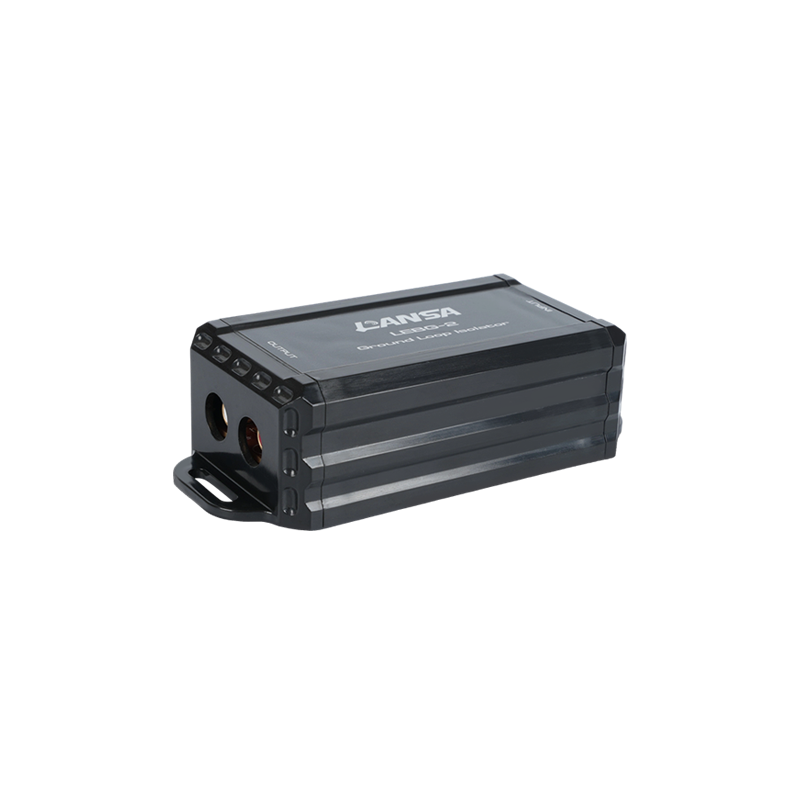
If the hum sits there steadily before the engine ever starts, a ground loop is the likely cause. The source and the amplifier are referenced to slightly different ground potentials, and the difference travels along the RCA shield. An in-line isolator breaks that galvanic path at line level, which is the least invasive place to fix it and keeps the power wiring untouched. Our LEBG2 is built for exactly this job.
 LEBG-2 Ground Loop Isolator for Car AudioFor steady hum that starts before the engine, this line-level isolator breaks the RCA ground path without touching power wiring.View Product →
Noise that only arrives once the engine runs
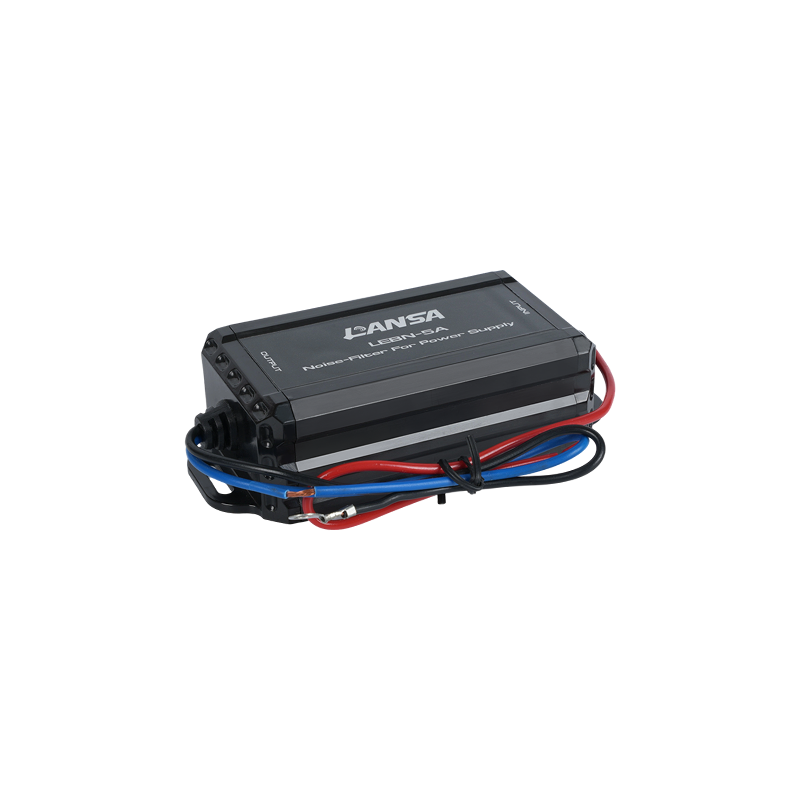
If the noise appears with the engine and tracks rpm, the charging system is feeding ripple into the 12 V rail, and the filter belongs on the power feed rather than in the signal path. The LEBN5A is our 5 A engine noise filter, sized for a head unit, an equalizer or a signal processor drawing modest current.
 LEBN-5A 5 A Engine Noise FilterFor rpm-linked engine noise, this 5 A filter is sized for head units, equalizers and signal processors drawing modest current.View Product →
The two are not mutually exclusive. In a heavily loaded system with several sources and long cable runs, an installer may well end up with a filter on the power side and an isolator at line level, and that is a normal outcome rather than a sign that something was done wrong.
Matching the Filter to the Symptom and the Current Draw
This is the short version we share with installers who are building a stock list and want one part per symptom rather than a shelf of near-duplicates.
| Model | Type | Where it installs | Symptom it targets | Rating |
|---|---|---|---|---|
| LEBG2 | Ground loop isolator | In line with the RCA signal, between source and amplifier | Steady hum or whine present with the engine off | Line level |
| LEBN5A | Engine noise filter | Inline on the 12 V feed to a head unit or processor | Whine that rises and falls with engine rpm | 5 A |
| LEBN15A | Engine noise filter | Inline on the 12 V feed to higher-draw equipment | Whine that rises and falls with engine rpm | 15 A |
Current draw is the detail people skip. A 5 A part placed on a circuit that pulls well beyond that will run warm and eventually fail, and the failure will be blamed on the filter rather than on the specification. When the load is heavier, the LEBN15A covers the same symptom with more headroom.
 LEBN-15A 15 A Engine Noise FilterWhen current draw exceeds a 5 A filter's limit, this 15 A RMS unit offers more headroom for mid- to high-power car audio systems.View Product →
The complete range, including the connector and packaging options we hold in stock, sits on our noise filter category page.
A Diagnostic Order That Saves Returns
Most filters that come back to us are not faulty. They were fitted before anyone established where the noise was entering, so they had no chance to help. This sequence takes about twenty minutes and settles the question.
- Reproduce the noise twice: engine off with the ignition in accessory, then engine running. Note which one produces it and whether it follows rpm.
- Unplug the RCA inputs at the amplifier. If the noise disappears, it is entering through the signal path; if it stays, it is arriving on the power or ground side.
- Check every ground between battery, chassis, head unit and amplifier. Clean the contact points and re-torque before adding any part to the system.
- Re-route the RCA leads away from power cable and from the amplifier's power terminals, and listen again before deciding anything.
- Set gain with the engine running and the head unit at roughly three-quarters volume. If gain has to sit near maximum to reach a normal listening level, the problem is signal level, and a line output converter is a better answer than a noise filter.
- Only now fit the filter that matches what the tests showed, on the circuit those tests identified.
Doing it in this order also gives the installer something useful to write on the job sheet, which matters when a customer asks why a part was fitted.
What We Check Before a Filter Leaves the Line
A noise filter is a small, largely passive part with nowhere to hide. Either it isolates properly and passes clean current, or the customer finds out the first time the alternator spins. A few points get attention on our side of the fence.
- Current headroom. The rating on the housing has to reflect what the part will survive in a warm footwell or under a dashboard, not what it manages on a bench at room temperature.
- Isolation and continuity. Input and output are checked for the isolation the design calls for, and for the continuity a good joint should give.
- Connector and solder quality. SMT placement, AOI inspection and wave soldering are part of our standard lines, and lead dress is checked because a filter that rattles loose in a door panel fixes nothing.
- Vibration and mounting. Parts intended for engine-adjacent locations are built to stay put, since a filter that works loose becomes a new fault of its own.
- 100% functional check and burn-in. Every unit is tested on our AP stations and run through burn-in before packing, which is how we would rather find a problem than have an installer find it.
None of that replaces a proper diagnosis in the vehicle. It simply means the part arriving in the box does what the label says, which is the minimum anyone should expect.
Installation Habits That Decide the Outcome
Two identical filters can perform quite differently depending on where they sit and how they are wired. In our experience the following habits account for most of the gap.
- Ground the equipment to bare metal on the chassis, not to a painted surface or an existing screw that already carries another ground.
- Keep ground leads short and take them to a single nearby point rather than daisy-chaining across the vehicle.
- Run the filter's own leads away from high-current cable; a filter laid alongside a power run can pick up what it is meant to reject.
- Fit power-side filters where they stay dry and accessible, and check that the circuit's fuse rating still protects the added component.
- Label the work. The next person in the vehicle should be able to see what was fitted and why.
When a Filter Is Not the Answer
There are cases where we would rather not sell a filter. A failing alternator diode, a battery on its way out, a corroded battery terminal or an amplifier that has lost its internal ground will all produce noise that no external part can clean up. A gain control pinned at maximum, or an input stage being fed a signal far hotter than it expects, produces the same result. In those situations the honest advice is to repair or reset the system first and revisit the filter only if something remains.
Working With Us on Noise Filter Supply
Hangzhou Newsources Electronics has grown from a single workshop in 1997 into three production sites covering roughly 37,000 m², with more than 150 staff and over 15 assembly lines. Our catalogue runs from Class A/B and Class D car amplifiers through marine and powersport amplifiers to the accessories that complete an installation: line output converters, bass processors, in-dash equalizers, crossovers, Bluetooth modules and noise filters.
If you are specifying a filter for a range you distribute, we are happy to go through current rating, connector type, cable length and packaging with you rather than simply quoting a part number. That conversation usually takes less time than a return shipment, and it tends to produce a better shelf anyway.